

Recycling in Korea has more streams than most newcomers are used to, and the rules are enforced building by building. Most of it comes down to four habits: empty it, rinse it, dry it, and pull apart anything made of two materials. This guide covers plastic, paper, glass, cans, vinyl and styrofoam — and the things that look recyclable but belong in your general-waste bag. It’s part of our waste series; for the overview, start with our waste separation guide.
Empty, Rinse, Dry, Separate
Recyclables are sorted again after collection, so anything with food or liquid still in it spoils what it’s mixed with. The national sorting guideline says it plainly: empty the contents, rinse off what’s left, let it dry, and remove parts made of a different material — labels, the plastic lid on a can, the metal spring inside a pump bottle. If you can’t get something clean, it goes in the jongnyangje bag (종량제봉투) instead. That single decision covers most of the hard cases.
Clear PET Bottles Go Out on Their Own
This is the rule that catches people out. Colourless, transparent PET bottles — bottled water and most soft drinks — are collected separately from all other plastic. Peel off the label, rinse the bottle if the drink was sugary, crush it, put the cap back on, and put these bottles in a clear or translucent bag of their own. Coloured PET bottles and every other plastic container go in the general plastics stream.
Paper, Cardboard and Cartons
- Cardboard boxes: take off tape, staples and any plastic coating, then flatten them.
- Drink cartons (milk, soy milk, juice): rinse, dry, remove straws, and use the carton-only bin if your building has one. If it doesn’t, tie them in their own bundle so they can be told apart from ordinary paper.
- Newspaper, books and flyers: keep them dry, stack them flat and tie them. Take off spiral bindings and plastic covers first.
- Paper cups: rinse, flatten, and bag or tie them together.
Some paper isn’t paper once it reaches the sorting line. Receipts and delivery labels are thermal paper, and photo paper, baking paper, paper with foil in it, used tissue and waterproof posters can’t be recycled either. All of it goes in general waste.
Glass Bottles, and the Deposit You Get Back
Rinse bottles out and put them out whole, colour and all. Beer and soju bottles carry a refundable deposit that is already built into the price — take the empties back to a shop and you get that money back.
What doesn’t go out with the bottles: broken glass, which you wrap in newspaper and put in your general-waste bag; heat-resistant glass, crystal, mirrors, window glass and light-bulb glass; and ceramics such as plates and flower pots. Depending on your district, those go in a reinforced sack (특수규격마대) or out as bulky waste.
Cans and Metal
Rinse drink and food cans and take the plastic lids off. Butane canisters and spray cans have to be emptied first: press the nozzle somewhere well ventilated until nothing comes out. Cans that still hold paint, adhesive or anything flammable are treated as hazardous household waste — seal them, mark what’s inside, and use your district’s hazardous-waste bin. Aluminium foil is not a can and goes in general waste. Scrap metal like tools, wire and nails can be bagged or tied and put out with the metal.
Plastic Containers, Vinyl and Styrofoam
- Containers and trays: rinse, peel off labels, and pull out pump tops that have a metal spring inside. Containers you can’t rinse, like toothpaste tubes, just need to be emptied.
- Vinyl and plastic bags (비닐): rinse anything with food on it, then collect them all in one clear or translucent bag so they don’t blow around.
- Styrofoam: rinse it and peel the labels off. Food-stained styrofoam and construction foam aren’t recyclable.
- Not plastic recycling, whatever they’re made of: hangers, toothbrushes, stationery, CDs and DVDs, suitcases and golf bags. Those are general waste, or bulky waste if they’re large.
Where and When You Put It Out
The sorting rules for recycling in Korea are national, but collection is run by your district, which sets the days and the setup. What that looks like depends on your building:
- Apartments usually have a recycling area with labelled bins, open on set days or all week.
- Villas and one-room buildings often follow a district collection day, with recycling going out on one or two nights a week. Where integrated collection is used, most items go in one designated bag, while PET bottles, glass, paper, styrofoam, clothing, batteries and light bulbs still go out separately.
- Some neighbourhoods have a drop-off point (재활용 동네마당) you can use any time.
Your building’s own rule is the practical answer, so ask your landlord or the building manager when you move in and read the notice by the bins. Sorting is a legal duty under the Waste Management Act, with the details left to each district’s ordinance, and getting it wrong can in principle bring a fine of up to one million won. Day to day, what actually happens is that your bag gets a sticker and is left behind.
Quick Reference
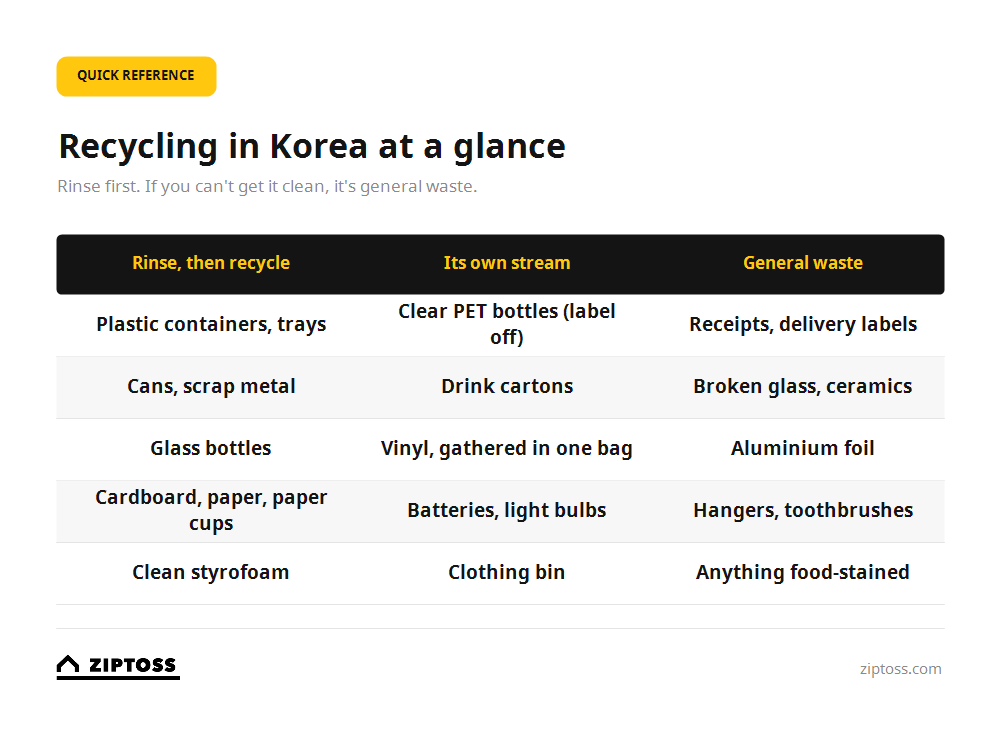
| Rinse → recycle | Its own stream | General waste |
|---|---|---|
| Plastic containers, trays | Clear PET bottles (label off) | Receipts, delivery labels |
| Cans, scrap metal | Drink cartons | Broken glass, ceramics |
| Glass bottles | Vinyl, gathered in one bag | Aluminium foil |
| Cardboard, paper, paper cups | Batteries, light bulbs | Hangers, toothbrushes |
| Clean styrofoam | Clothing bin | Anything food-stained |
A Few Things That Trip People Up
- On a PET bottle it’s the shrink label around the body that has to come off. The cap goes back on before you put the bottle out.
- Batteries and light bulbs have their own bins, usually by the recycling area or at the community centre (주민센터).
- Small electronics go in a separate bin, and large appliances are collected for free. Our bulky waste guide covers both.
- Food waste is its own system again, with its own bag or card — see our food waste guide.
- When you’re unsure, general waste is the safer choice. One dirty item can spoil a whole batch of recycling.
Settling In Without the Guesswork
Sorting stops being a chore once the habits are in place: rinse as you go, keep one bag for vinyl and one for clear PET bottles, and check the notice by your building’s bins for collection days. For the whole system at a glance, see our waste separation guide. And if you’re still looking for a place to live, tell us what you need through our inquiry form and we can help you find one that fits.
Browse Available Properties on Ziptoss →
Explore the Seoul rental map, filter by area, and inquire directly.