

Korea separates food waste from regular trash, and sorting it wrong is one of the most common early mistakes — partly because the line between “food waste” and “general waste” isn’t always obvious. Bones, shells, and fruit pits, for example, aren’t food waste at all. This guide clears up what goes where, including the recycling traps that catch almost everyone. It’s part of our waste series; for the full overview, start with our waste separation guide.
The Simple Rule: Could an Animal Eat It?
Food waste in Korea is collected to be turned into animal feed and compost, so the rule of thumb is simple: if an animal could eat it, it’s food waste (eumsingmul, 음식물). If it’s hard, sharp, or inedible — bones, shells, pits — it’s general waste, even though it came from food. It’s a rough guide, not a perfect one, and districts vary, so check your local rules when in doubt.
What Goes in Food Waste (음식물)
- Leftover rice, noodles, bread, and cooked dishes
- Soft fruit and vegetable scraps — apple, tangerine, and banana peels, and similar
- Small, soft food scraps in general
Drain off any liquid first, and remove anything that isn’t food — stickers, packaging, and the items below.
What Is NOT Food Waste (It Goes in General Waste)
These come from food but can’t become feed or compost, so they go in your general-waste bag:
- Bones of any kind — beef, pork, chicken, and fish bones
- Shells — clam and other shellfish shells, and eggshells
- Hard shells and husks — walnut, chestnut, peanut, coconut, and pineapple skin
- Fruit pits and hard seeds — peach, plum, persimmon
- Onion and corn husks, corn cobs, and the roots of green onion and leek
- Tea bags, toothpicks, and disposable items
How to Throw Out Food Waste
How you dispose of it depends on your building, so check when you move in. The common methods are:
- An RFID food-waste machine: tap your registered card, drop in the waste, and you’re billed by weight.
- Designated food-waste bags: buy them locally and put them out on collection days.
- A communal food-waste bin for your building.
Whichever you use, drain the liquid and keep packaging out — only food goes in.
The Recycling Trap: When It’s Actually General Waste
Here’s where almost everyone slips up. Recyclables have to be clean, empty, and dry. If something is soaked in food or grease and you can’t rinse it clean, it belongs in general waste — not the recycling.
- Delivery-food containers with sauce or food stuck to them (rinse and dry them and they can be recycled; if not, general waste)
- Greasy pizza boxes and food-stained paper
- Used paper cups, which have a plastic coating inside
- Dirty plastic wrap, bags, and food-smeared styrofoam
- Receipts, which are printed on thermal paper and can’t be recycled
One quick habit fixes most of this: give containers a rinse before recycling. A few items are a special case — broken glass, ceramics, mirrors, and light bulbs go in a special reinforced sack (teuksu made, 특수마대) or a designated drop-off, not the regular bag.
General Waste and the Jongnyangje Bag
Everything that isn’t food waste or recycling — including the food-related exceptions above — goes in a jongnyangje bag (종량제봉투), the district’s paid volume-rate bag. These are specific to your gu (district), so buy your area’s bag at a nearby convenience store or supermarket.
Quick Reference
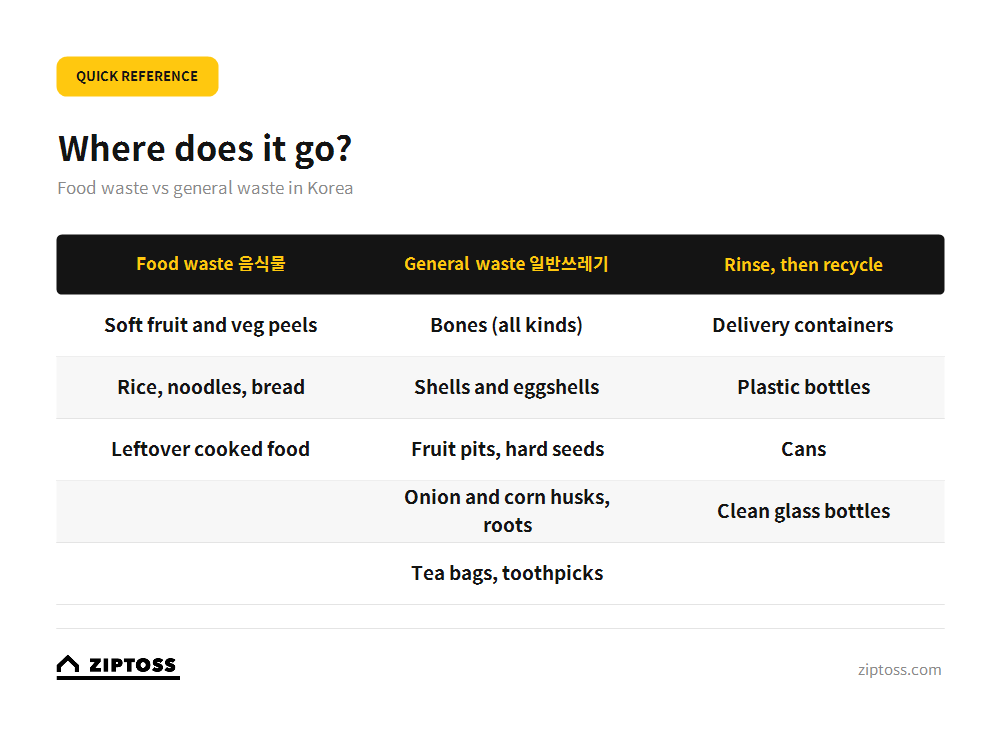
| Food waste (음식물) | General waste (일반쓰레기) | Rinse → recycle |
|---|---|---|
| Soft fruit/veg peels | Bones (all kinds) | Delivery containers |
| Rice, noodles, bread | Shells & eggshells | Plastic bottles |
| Leftover cooked food | Fruit pits, hard seeds | Cans |
| Onion/corn husks, roots | Clean glass bottles | |
| Tea bags, toothpicks |
A Few Tips
- Drain liquid from food waste before you throw it out.
- Take stickers and packaging off before recycling.
- When you can’t rinse it clean, it’s general waste.
- Rules vary by district — check your local guidance if you’re unsure.
Sorting It Out at Home
Once you know that bones and shells are general waste and a rinse turns a delivery box into recycling, sorting becomes second nature. For the everyday overview, see our waste separation guide, and for large items there’s our bulky waste guide. If you’re still looking for a place to call home, tell us what you need through our inquiry form and we can help you find one that fits.
Browse Available Properties on Ziptoss →
Explore the Seoul rental map, filter by area, and inquire directly.