

Lease renewal in Korea is the moment most foreign tenants have no reference point for. Your landlord names a new rent, and you have no idea whether it is normal, or what the law lets them ask. Ziptoss went through the government’s rent filings for Seoul, including the previous contract terms recorded on each one, and worked out what renewals actually cost over the twelve months to July 2026.
The short version: the typical renewal costs 30,000 won a month more, and the law caps how much more it can be.
What a renewal actually costs
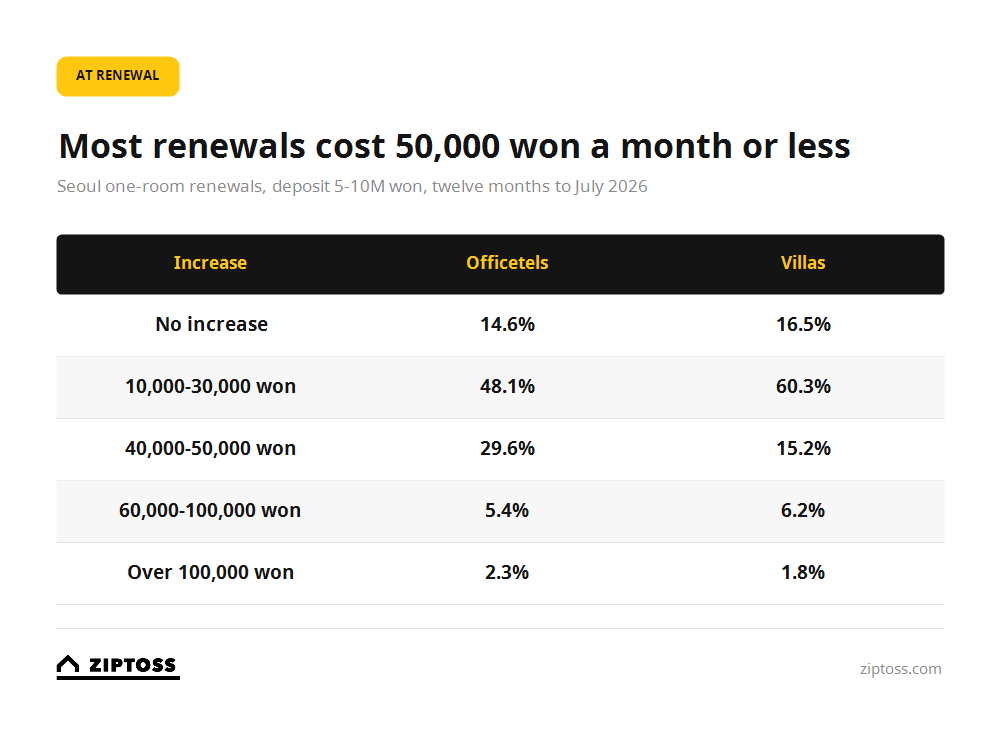
Across 4,790 renewals of small units on a deposit between 5 and 10 million won, the median increase was 30,000 won a month. Almost one in six came with no increase at all.
| Increase at renewal | Officetels | Villas |
|---|---|---|
| No increase | 14.6% | 16.5% |
| 10,000–30,000 won | 48.1% | 60.3% |
| 40,000–50,000 won | 29.6% | 15.2% |
| 60,000–100,000 won | 5.4% | 6.2% |
| More than 100,000 won | 2.3% | 1.8% |
Around 92 percent of renewals in both building types came in at 50,000 won a month or less. So if you are asked for 100,000 won more, you are being asked for something that happened to about two percent of tenants. That is worth knowing before you agree to it.
The five percent cap, and what it actually applies to
Under the Housing Lease Protection Act, a landlord asking for more cannot demand more than one twentieth — five percent — of the agreed rent or deposit. A city or province can set a lower ceiling than that, but not a higher one. The same article also blocks any increase within one year of the contract or of the last increase.
Two details matter here. The five percent limit applies to the rent and to the deposit separately, not to the two added together. And the Act covers residential leases, including a building only partly used for living — which is why a residential officetel is covered even though it is legally an office-type building.
In the filings, the median renewal came in at 3.9 percent on that combined basis, comfortably inside the cap. Seventeen percent went above five percent, which is not automatically unlawful: the ceiling bites when the tenant exercises the statutory renewal right, while a freely negotiated new contract is a different matter.
The renewal right, and what the filings show
You can require your landlord to renew once. The Act gives the tenant a renewal right that the landlord cannot refuse without one of nine specific reasons, and the renewed lease runs for two years on the same terms, with rent and deposit adjustable only within that five percent limit. The same three-month notice applies to a lease renewed this way (Article 6-3).
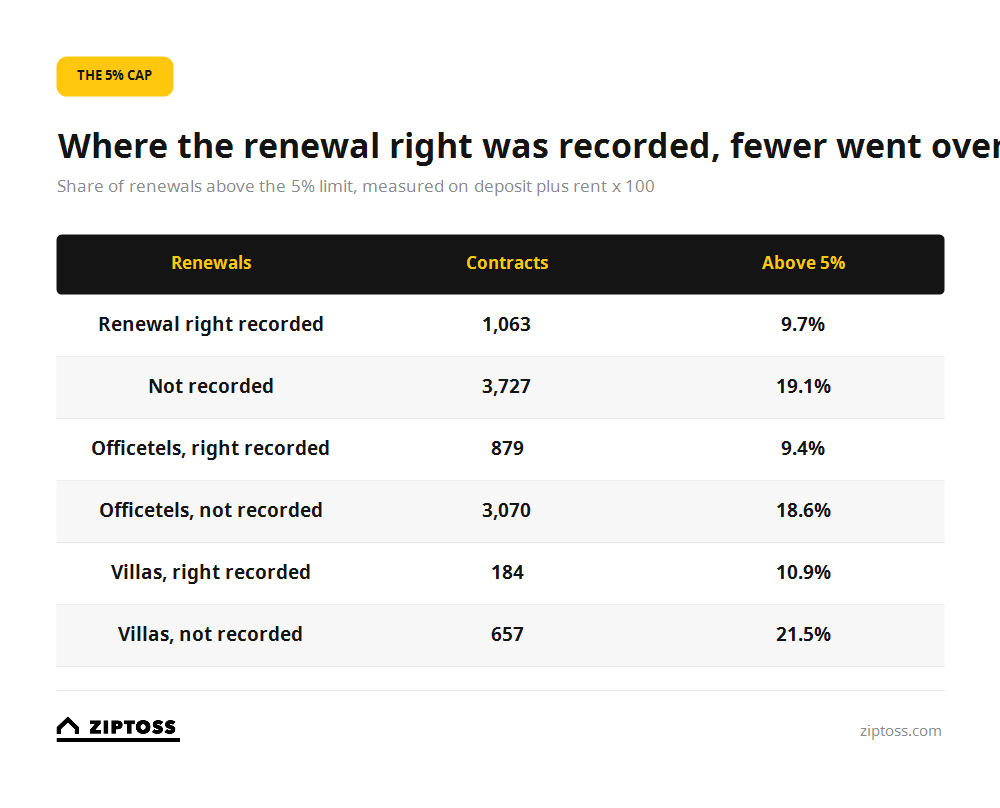
Filings record whether that right was used. The pattern is worth seeing.
| Renewals | Contracts | Above 5% | Median increase |
|---|---|---|---|
| Renewal right recorded as used | 1,063 | 9.7% | 4.0% |
| Not recorded | 3,727 | 19.1% | 3.9% |
The middle of the two groups is nearly identical. What differs is the tail: where the renewal right was recorded, roughly half as many contracts landed above the cap, and the same gap shows up separately in officetels (9.4 against 18.6 percent) and villas (10.9 against 21.5 percent).
Read that carefully, though. A blank field means the right was not recorded on the filing, not that no tenant invoked it. And this is an association rather than proof of cause: a landlord set on a large increase may well be the one who steers the tenant away from a statutory renewal in the first place. What the figures support is a modest claim, which is still a useful one: contracts where the right appears are contracts that stayed inside the limit more often.
When you have to say something
Timing is the part that catches people out, because the window closes earlier than most tenants expect.
- The landlord must give notice of refusal between six months and two months before the lease ends. Miss that window and the lease is treated as renewed on the same terms, for two years. That is not a lock-in. The tenant can give notice at any time, and the lease ends three months after the landlord receives it (Article 6-2). Those three months are the landlord’s period to find the next tenant.
- The tenant must give notice no later than two months before the end. Say nothing and the same automatic renewal applies.
- The statutory renewal right is exercised inside that same window, and it can be used once.
Put a reminder in your phone for seven months after move-in. Sorting this out in writing, by message or email, is worth more than any verbal agreement — our guide to reading a Korean lease covers what else belongs in writing.
When a landlord can say no
The nine grounds for refusal are specific. The ones tenants meet in practice are rent arrears of two months’ worth, subletting without consent, serious damage to the unit, demolition or rebuilding, and the landlord or their immediate family moving in.
That last one carries a consequence people rarely mention. If a landlord refuses renewal in order to live there and then lets the place to someone else instead without good reason, the Act makes them liable for the tenant’s loss, calculated on a formula that starts at three months of rent. You do not need to memorise it; you need to know it exists, and to keep the refusal in writing.
The renewal in short
Q: How much will my rent go up when I renew?
On the filings, the median increase was 30,000 won a month and about 92 percent of renewals came in at 50,000 won or less. One in six had no increase at all. A request far above that is unusual rather than standard.
Q: Can my landlord refuse to renew?
Only on one of nine grounds in the Act, such as two months of unpaid rent, unauthorised subletting, rebuilding, or the landlord’s own family moving in. Otherwise a tenant exercising the renewal right can require a two-year renewal, once. The tenant can still end that renewed lease by giving notice, which takes effect three months later.
Q: Does the five percent cap apply to my officetel?
The Act applies to residential leases, including buildings used only partly for living, so an officetel you live in is covered. Ask your agent to confirm how your specific contract is written before you rely on it.
Rent figures: Ministry of Land, Infrastructure and Transport rent filings for Seoul, August 2025 to July 2026 — units under 28 square metres let on monthly rent with a deposit above 5 and up to 10 million won, restricted to filings that record the previous contract’s deposit and rent, duplicates removed. Increases are measured on deposit plus monthly rent multiplied by 100. Legal points follow the Housing Lease Protection Act, Articles 2, 6, 6-2, 6-3 and 7. This is general information, not legal advice for a specific contract.
Thinking of moving instead? Talk to Ziptoss
A lease renewal in Korea is also a good moment to check what else your budget reaches. If the increase is steeper than the figures above, tell us your area and budget through our inquiry form and we can show you what is available nearby. Our guide to monthly rent in Seoul sets out what a small deposit rents across the city, and our deposit protection guide covers getting your money back when you do move.
Browse Available Properties on Ziptoss →
Explore the Seoul rental map, filter by area, and inquire directly.