
Hoegi rent prices come up in every conversation about living near Kyung Hee University or the Hankuk University of Foreign Studies, and the honest answer is that the campus itself tells you very little. Ziptoss went through the government’s rent filings for Dongdaemun-gu, the district that covers Hoegi, Imun, Hwigyeong and seven other neighbourhoods, and pulled out what people actually paid over the twelve months to July 2026.
Two things stand out. Nine neighbourhoods here have enough filings to compare directly, so a search can be narrowed street by street rather than district by district. And the cheapest of them sit right next to the campuses, not away from them.
Hoegi rent prices by neighbourhood
Medians below cover one-room units under 28 square metres on a deposit between 5 and 10 million won. Each figure is the midpoint of that neighbourhood’s filed contracts, not a quote for any one building.
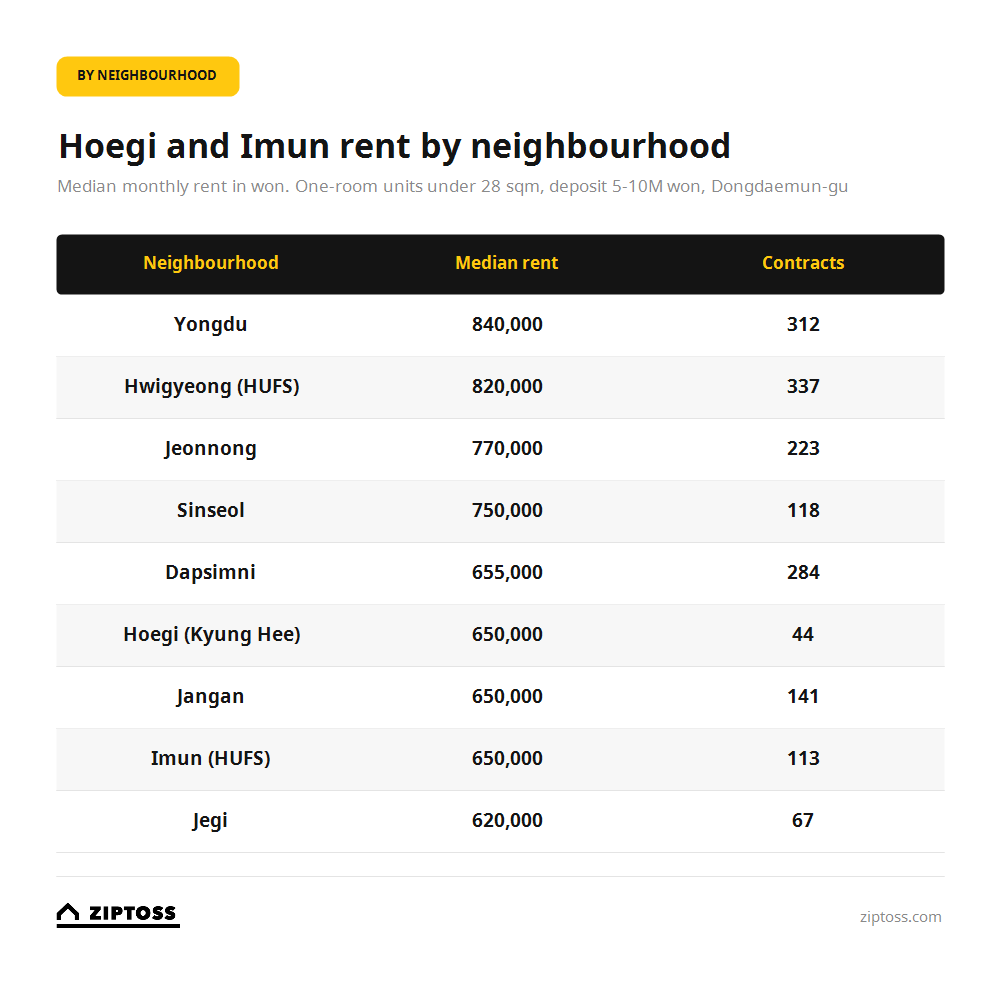
| Neighbourhood | Median monthly rent | Contracts |
|---|---|---|
| Yongdu-dong | 840,000 won | 312 |
| Hwigyeong-dong (HUFS, Hoegi Stn) | 820,000 won | 337 |
| Jeonnong-dong (Univ. of Seoul) | 770,000 won | 223 |
| Sinseol-dong | 750,000 won | 118 |
| Dapsimni-dong | 655,000 won | 284 |
| Hoegi-dong (Kyung Hee) | 650,000 won | 44 |
| Jangan-dong | 650,000 won | 141 |
| Imun-dong (HUFS) | 650,000 won | 113 |
| Jegi-dong | 620,000 won | 67 |
From top to bottom that is a spread of 220,000 won a month inside one district. Hoegi-dong, the neighbourhood at Kyung Hee’s main gate, sits near the bottom of it, and so does Imun-dong at the HUFS gate. Living next to a campus does not carry a premium here the way it does around Ewha or Yonsei.
One neighbourhood is missing on purpose. Cheongnyangni-dong shows a median of 1,050,000 won, but more than nine in ten of its filings come from a single new complex by the station, so the figure describes one building rather than a neighbourhood. If you are shown a unit there, treat it as its own market.
Hwigyeong or Imun: the two sides of HUFS
HUFS students end up choosing between Imun-dong and Hwigyeong-dong, which sit on either side of the university and are a short walk apart. The filings put 170,000 won a month between them, and the space goes the other way.
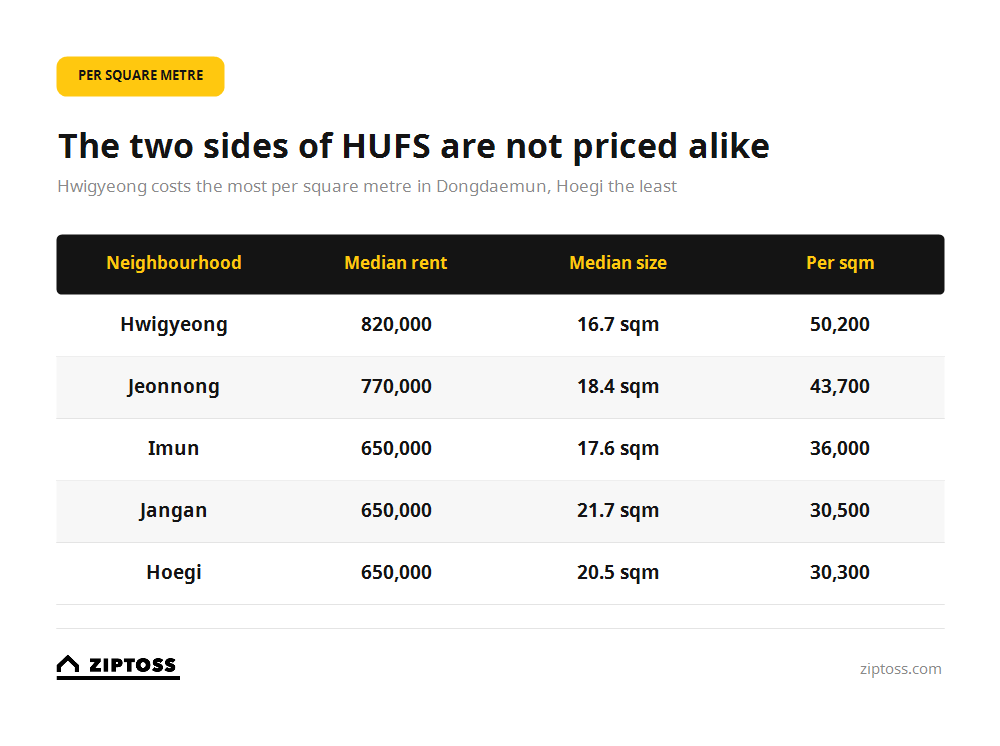
| Neighbourhood | Median rent | Median size | Per m² |
|---|---|---|---|
| Hwigyeong-dong | 820,000 won | 16.7 m² | 50,200 won |
| Jeonnong-dong | 770,000 won | 18.4 m² | 43,700 won |
| Imun-dong | 650,000 won | 17.6 m² | 36,000 won |
| Jangan-dong | 650,000 won | 21.7 m² | 30,500 won |
| Hoegi-dong | 650,000 won | 20.5 m² | 30,300 won |
Hwigyeong-dong is the most expensive square metre in the district and Hoegi-dong the cheapest, about 40 percent below it. The reason is the building stock rather than the location: Hwigyeong’s small-unit market is dominated by newer officetels, and its median unit is the smallest in Dongdaemun at 16.7 square metres. Imun-dong, a walk away on the other side of the campus, gives you slightly more room for 170,000 won less.
So if a listing near HUFS feels expensive, ask which of the two neighbourhoods it is in before you rule out the area. That one question is worth more than most of the filters on a listings site. For what living around here is actually like, our HUFS and Kyung Hee area guide covers the ground the numbers do not.
Rents here have risen faster than the Seoul average
Comparing the same August-to-July window across four years removes the seasonal swing and shows the direction of travel.
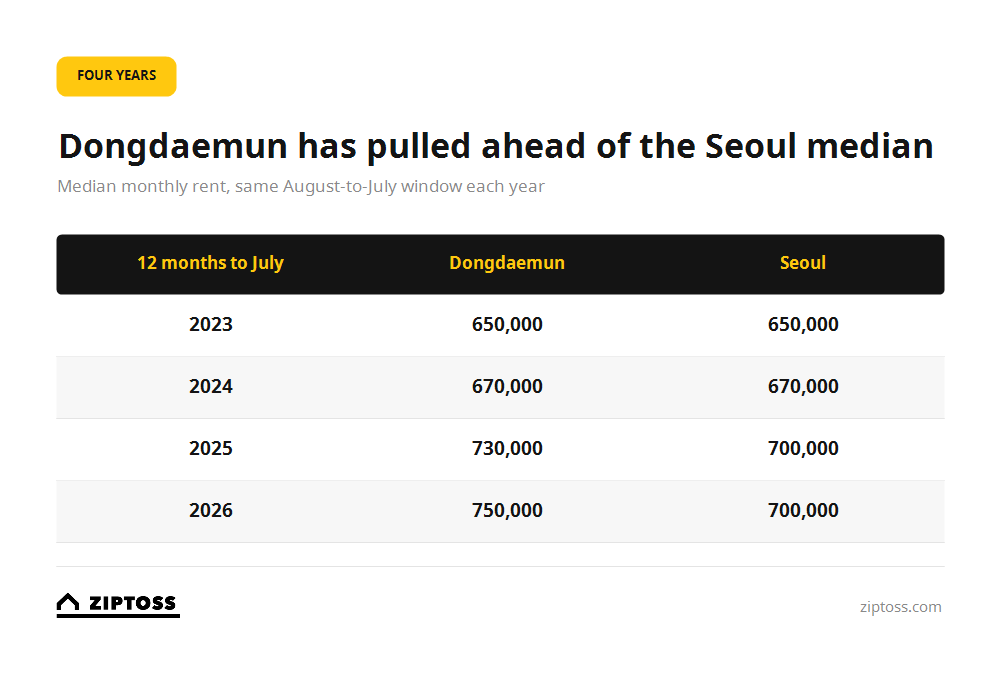
| Twelve months to July | Dongdaemun median | Seoul median |
|---|---|---|
| 2023 | 650,000 won | 650,000 won |
| 2024 | 670,000 won | 670,000 won |
| 2025 | 730,000 won | 700,000 won |
| 2026 | 750,000 won | 700,000 won |
Three years ago Dongdaemun matched the Seoul median exactly. It now sits above it. Split by building type, the gap has a clear source: officetel medians here went from 680,000 to 800,000 won, about 18 percent, while the Seoul figure rose about 12 percent. Villas moved 550,000 to 600,000 won, which is the same roughly 9 percent Seoul saw as a whole.
That is the practical takeaway. The officetel side of this district has been pulling away from the rest of the city, and the villa side has not. If your budget has stopped stretching, the villa stock is where the area still prices like it did.
Officetel or villa, and where each one actually is
A villa is a low-rise multi-household building, usually older, usually walk-up. An officetel is a managed building with a lift, built-in appliances and a secured entrance; our guide to officetels versus one-rooms covers the rest.
What the filings add is that the two types are not spread evenly across the district. Dapsimni-dong’s small-unit filings in this deposit band are almost entirely officetels, at a median of 655,000 won, which makes it unusually cheap for a managed building. Jegi-dong runs the other way and is mostly villas at 600,000 won. Hwigyeong-dong has enough of both to compare directly: 850,000 won for an officetel against 655,000 won for a villa, a gap of nearly 200,000 won in the same neighbourhood.
Hoegi-dong is the one to ask about rather than read about. Its filings split evenly between the two types but neither side has enough contracts to publish a reliable median, so the 650,000 won figure above covers both together.
What the numbers answer
Q: Is it cheaper to live further from Kyung Hee or HUFS?
Not necessarily here. Hoegi-dong at the Kyung Hee gate and Imun-dong at the HUFS gate both sit near the bottom of the district’s range, while Hwigyeong-dong between them is one of the most expensive. Building type and unit size explain more of the price than the walk to campus does.
Q: Which neighbourhood gives the most space for the money?
On these filings, Jangan-dong and Hoegi-dong. Both have a median of 650,000 won at around 21 square metres, while Hwigyeong-dong asks 820,000 won for a median of 16.7 square metres. If floor area is what you are short of, those two are the ones to put on the list first.
Q: Why is Cheongnyangni not in the table?
Because more than nine in ten of its small-unit filings come from one recently built complex near the station. A median calculated from that is a fact about one building, not about the neighbourhood, so we left it out rather than print a number that would mislead.
Source: Ministry of Land, Infrastructure and Transport rent filings for Dongdaemun-gu, August 2025 to July 2026, with the four-year comparison using the same August-to-July window in each year. Figures cover officetel and villa units under 28 square metres let on monthly rent with a deposit above 5 and up to 10 million won, duplicate filings removed. Neighbourhoods with fewer than 30 contracts, or where a single building accounted for more than 40 percent of them, are left out.
Find a place near Kyung Hee or HUFS with Ziptoss
If you have a deposit figure and a move-in date, tell us through our inquiry form and an agent can narrow the search by neighbourhood and building type in one go. For the wider picture, our guide to monthly rent in Seoul compares every district we cover, what newer buildings cost extra explains the age premium behind the Hwigyeong figures, and Sinchon and Hongdae is the same breakdown for the west-side campuses.
Browse Hoegi and Imun Listings on Ziptoss →
Filter by deposit, monthly rent and neighbourhood on the map.