
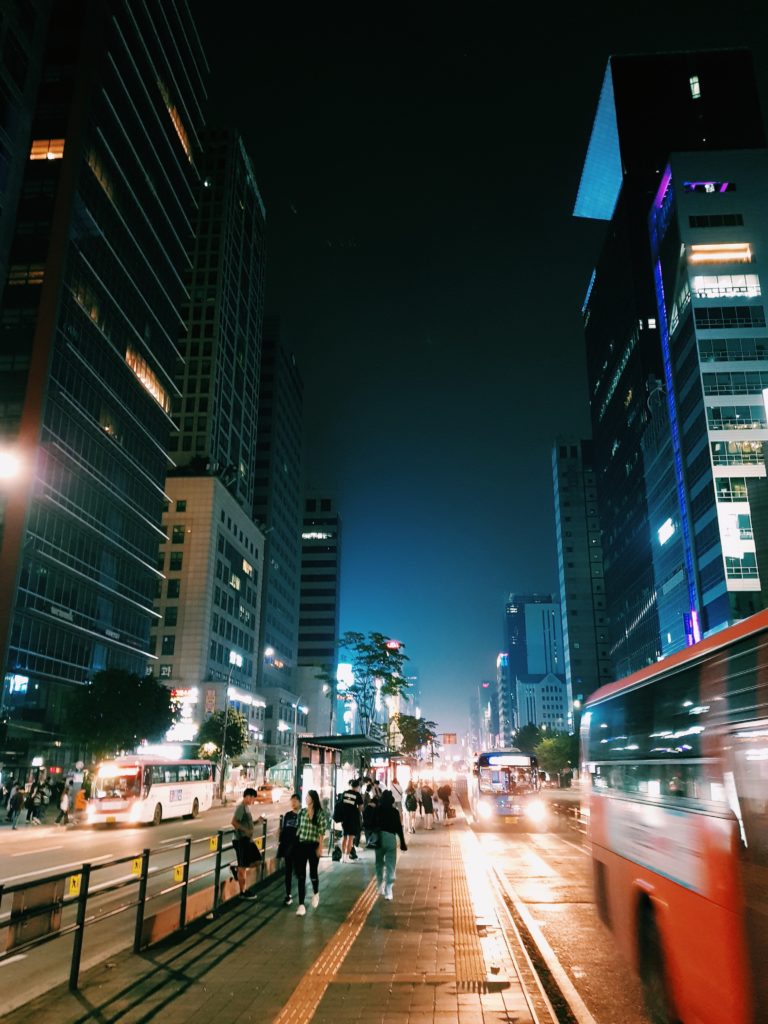
Seoul has one of the best public transport systems in the world — fast, clean, affordable, and easy to use once you know the basics. Subways and buses reach almost everywhere, taxis fill the gaps, and English support is good throughout. If you’ve just arrived, this guide covers everything you need to get around: the transit card to get first, how the subway and buses work, taxis, airport transfers, and the apps that make it all simple.
Start With a T-money Card
The first thing to set up is a transit card. T-money is the standard rechargeable card, and it works on the subway, buses, most taxis, and even at convenience stores. You tap it on the reader when you enter and exit.
- Where to get one: any convenience store (CU, GS25, 7-Eleven), station vending machines, and kiosks. Buy the card, then load cash onto it at the same places or at station machines.
- How to use it: tap on entry and again on exit. Tapping out matters — it sets the correct fare and keeps your free transfers valid.
- Alternatives: many foreign contactless credit cards and phone wallets now work by tapping directly at the gate, and travel cards like WOWPASS combine currency exchange with a transit card.
The Subway
The Seoul metro has more than ten numbered, color-coded lines covering the city and surrounding areas. Signs and announcements are in Korean, English, Chinese, and Japanese, so it’s very newcomer-friendly.
- Fares: the base fare is about 1,550 won by card, rising with distance. Tap in at the gate and tap out at your destination.
- Finding your way: use a map app (below) to see lines, transfers, and exit numbers — picking the right exit saves a lot of walking.
- Good to know: trains are frequent, air-conditioned, and have free Wi-Fi. Stand behind the line and let people off before boarding.
Buses
Buses fill in where the subway doesn’t reach, and they use the same T-money card. Seoul’s buses are color-coded by role:
- Blue: main trunk routes across the city
- Green: shorter branch routes connecting to subway stations
- Red: express buses to and from outer areas
- Yellow: short circular routes within a district
- Village buses (maeul, 마을버스): small local buses on hilly or narrow streets
The base fare is about 1,500 won for city buses and 1,200 won for village buses. Tap your card when you board and again when you get off, so the system can calculate distance and keep your transfer free.
Free Transfers
One of the best features: with a transit card, transfers between subway and bus, or bus and bus, are free within 30 minutes — you’re only charged extra for additional distance, not a whole new fare. This only works if you tap both on entry and exit every time, so make it a habit.
Taxis
Taxis are plentiful and reasonably priced. A regular taxi’s base fare is around 4,800 won, then it rises by distance and time. You can hail one on the street (a red light means it’s available), wait at a taxi stand, or book through an app.
- Apps: Kakao T is the most widely used and has an English interface; UT (Uber) also works in Seoul.
- Paying: most take card and T-money as well as cash. Tipping is not expected.
- Tips: show your destination in Korean if you can, and note there’s a late-night surcharge (roughly 20% from around 10 p.m., higher in the small hours).
Getting To and From the Airport
From Incheon Airport, the AREX airport railroad runs to Seoul Station, connecting to the subway; airport limousine buses reach many neighborhoods directly; and taxis are available around the clock. Gimpo Airport is closer to the city and connects by subway and bus. For a first arrival with luggage, the limousine bus or a taxi is often the easiest.
Handy Apps
Two map apps do almost everything: Naver Map and Kakao Map both give accurate public-transport directions in English, with real-time arrivals and the best exits. Kakao T handles taxis. Google Maps is limited for driving directions in Korea, so the local apps are worth downloading on day one.
A Note on Transit Passes
If you commute daily, Korea offers discounted monthly and refund-based transit pass programs that can save regular riders money. These programs are being reorganized during 2026, so check the latest official information for the current options and prices before signing up. For everyday use, a simple T-money card is all you need to start.
Getting Around With Ease
With a T-money card and a map app, you’ll be moving around Seoul confidently within your first days. For more on settling into a new place, see our move-in setup guide. And if you’re still looking for a home near the lines you’ll use most, tell us what you need through our inquiry form and we can help you find one that fits.
Browse Available Properties on Ziptoss →
Explore the Seoul rental map, filter by area, and inquire directly.